05 Phase unwrapping
Pipeline: examples/05_unwrap.toml. Tutorial: nbs/Tutorials/CLI/CampiFlegrei/05_unwrap.ipynb.
Needs 04_refine.
Set [vars] shape to the (nlines, width) of raw/rslc.zarr and the pixel spacings to the ones of the
data (range_pixel_spacing, azimuth_pixel_spacing in meters, from a *.rslc.par); the defaults are the ones of
the sample data set (981 x 4160, 2.329562 m and 13.9516 m).
Steps
pc-gix: grid index of the refined points (from their hilbert index).image-pairs: sequential pairs (bandwidth 1).mcf-pc: minimum cost flow unwrapping on a Delaunay network of the points (in meters from the pixel spacings), every interferogram alone, several at the same time (moraine's own implementation: exactly optimal, independent of the point order;earth_costsets the cost of phase jumps across the border of the point cloud, default 1;spatial_cost = "length"places them first on long edges).gamma-mcf-ptuses GAMMA'smcf_ptinstead and takes e/n; its results differ by 2 pi at some points in low coherence areas, where several unwrappings are equally good.pc-pyramidof the unwrapped phase on the map.
Output: WORK/unw/pc_unw.zarr (n_points, n_image_pairs) float32, unwrapped phase in radians.
Expected results (sample data, Campi Flegrei, 330 754 points, 91 sequential interferograms)
| result | sample value | sane range |
|---|---|---|
unw/pc_unw_pyramid |
p01 -7.1, p50 -0.15, p99 5.8, min -17.3, max 14.5 | a few multiples of 2 pi |
Run time: 1.7 s for the 91 interferograms (CPU, 128 cores); the pyramid takes 5 s.
Correctness check (in python): rewrapping the result must give the input phase,
np.angle(np.exp(1j*unw) * np.conj(intf)) near 0 (sample: max 5.6e-7 rad).
Figures
Quicklook of the sample data run of 2026-10-10 (the numbers above are from the same run):
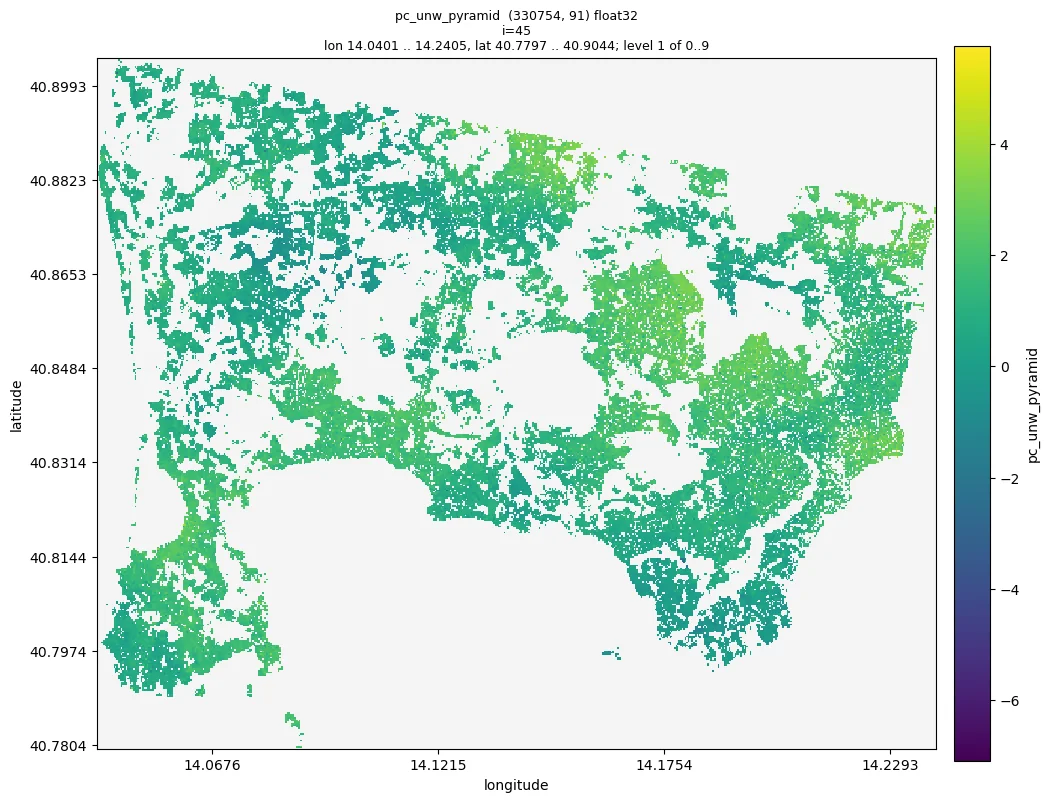
Unwrapped sequential interferogram 45 (2020-07-07 / 2020-07-19, unw/pc_unw_pyramid --index 45): smooth, within a
few radians (12 days of uplift and atmosphere), no isolated 2 pi jumps.
Alternative: EMCF
emcf-pc unwraps a redundant network instead of sequential pairs: the interferograms of a network of
image pairs that closes loops, e.g. every image with the next three (image-pairs with bandwidth = 3),
unwrapped together. The pixel spacings convert the grid index to meters (from the *.rslc.par of the
data; 2.329562 m in range and 13.9516 m in azimuth for the sample):
[[step]]
name = "pairs_hop3"
run = "image-pairs"
rslc = "pc/pc_ph.zarr"
bandwidth = 3
out = "unw/pairs_hop3.txt"

[[step]]
name = "unwrap_emcf"
run = "emcf-pc"
gix = "unw/pc_gix.zarr"
ph = "pc/pc_ph.zarr"
image_pairs = "unw/pairs_hop3.txt"
unw_ph = "unw/pc_unw_emcf.zarr"
range_pixel_spacing = 2.329562
azimuth_pixel_spacing = 13.9516
Sample data (2026-10-10): 270 interferograms of 92 images 14 s for the 330 754 refined points; rewrapping
gives the input phase (max 2.3e-6 rad). The loops of image pairs do not close at every point after EMCF: on
the sample loops fail at 1.1 % of the points with on average 0.01 % of the interferograms of a point not fitting
them. The phase closure correction is a separate step, after emcf-pc or mcf-pc; it also gives the unwrapped
phase of every image:
[[step]]
name = "closure"
run = "unwrap-correct-closure-pc"
gix = "unw/pc_gix.zarr"
ph = "pc/pc_ph.zarr"
unw_ph = "unw/pc_unw_emcf.zarr"
image_pairs = "unw/pairs_hop3.txt"
ts = "unw/pc_ts.zarr"
misclosure_fraction = "unw/pc_misclosure_fraction.zarr"
change_fraction = "unw/pc_change_fraction.zarr"
region = "unw/pc_region.zarr"
range_pixel_spacing = 2.329562
azimuth_pixel_spacing = 13.9516
Where the loops do not add up to zero, every region (points connected without edges longer than 4 times
the median edge length, e.g. a cluster or an island) is shifted by whole cycles in the interferograms that
disagree with the majority (MintPy's phase closure correction, decision 0021); points of regions of fewer
than 30 points are corrected one by one and marked -1 in region. Where the correction of its region does
not close every loop of a point, the interferograms fitting most of its loops are kept (decision 0022). Sample
data: 10 s, 87 regions (0.4 % of the points in smaller ones), the unwrapped phase changed at 1.1 % of the
points, on average in 0.01 % of their interferograms (change_fraction p99 0.004, max 0.07).
Output: ts (n_points, nimages) float32, the unwrapped phase of every image in radians relative to image
ref (default 0, its column is 0); interferogram (a, b) is ts[:, a] - ts[:, b], so every loop closes.
Rewrapping ts[:, j] gives the phase of ph[:, j] * conj(ph[:, ref]) (sample: max 3.7e-06 rad). ts has no
spatial reference yet: compare points only relative to each other. Without a truth it is unknown whether every
change is right: it relies on most interferograms of a region being right, so look at the quicklooks of ts,
misclosure_fraction and change_fraction. 10 million points, 100 images, 294 interferograms: 145 s, 3.3 GB
peak memory.
change_fraction, the share of the interferograms of a point that the correction changed, is the point
quality of this step for masking: on synthetic data with known truth it separated points wrong in at least
one interferogram from right ones better than misclosure_fraction (area under the ROC curve 0.55-0.96).
The threshold depends on the data; there is no default. No measure of this step sees errors that close every
loop, e.g. the same whole cycles in every interferogram of one image (0.4-9 % of the points without any
misclosure were wrong after emcf-pc on the synthetic data): combine it with the phase quality (temporal
coherence) of the points. ph must be chunked one image per chunk
(docs/contracts/data.md). Large data: 10 million points, 100 images, 294 interferograms take 13 min with
4 interferograms at the same time (8.2 GB peak memory) and 6 min with 32 (51 GB, the default on a
32 core machine is bounded by the cores and half of the available memory).
temporal_cost = "length" (with dates, the acquisition dates) corrects the longest interferograms first
where loops disagree; spatial_cost = "weight" (with weight, e.g. the temporal coherence) places phase
jumps first at points of low quality, spatial_cost = "length" on long edges. Both costs are
constant by default; on synthetic data with known truth (tests/unwrap_benchmark.py) the median share
of wrong (point, interferogram) is 0.83 % against 1.54 % when every interferogram is unwrapped alone with
mcf-pc (decision 0020).
Checks
moraine info unw/pc_unw_pyramid: no warnings; values within a few tens of radians.moraine quicklook unw/pc_unw_pyramid --index I -o unw.png: smooth, no isolated 2 pi jumps between neighbouring areas. The Delaunay network connects all points, so point clusters separated by large gaps (water, vegetation) are linked by long edges, where 2 pi errors between clusters are most likely.
Problems
mcf-pcneeds unique points (unique gix); the refined points from04_refineare unique.- Unwrapping errors along gaps: more points (lower thresholds in 02-04) make the network denser.