04 Merge PS and DS, refine with n2ft
Pipeline: examples/04_refine.toml. Tutorial: nbs/Tutorials/CLI/CampiFlegrei/04_refine.ipynb.
Needs 02_ps and 03_ds.
Steps
pc-unionof the DS (their phase history) and the PS candidates (their rslc), with e/n; a point in both sets keeps the DS phase history (the first input ofpc-unionwins);ras2pcadds lon/lat.image-pairs(sequential) andn2ft: Noise2Fringe Transformer filtering of the point cloud interferograms (chunks of 20 000 points with k nearest neighbour halos).temp-cohbetween the filtered and the raw phase; points with temporal coherence > 0.8 are kept (pc-logic-pc,pc-select-data).
Outputs (WORK/pc/): merged candidates pc_can_*; refined points pc_hix.zarr, pc_ph.zarr
(n_points, nimages), their coordinates pc_e.zarr, pc_n.zarr, pc_lon.zarr, pc_lat.zarr, their temporal
coherence pc_temp_coh.zarr, and the geometry the deformation products need: height pc_hgt.zarr, look vector
pc_theta.zarr, pc_phi.zarr (GAMMA elevation and orientation angles, radians) and slant range pc_range.zarr
(m); pyramids pc_can_temp_coh_pyramid, pc_ph_pyramid.
Parameters
- Temporal coherence threshold: 0.7-0.85; lower keeps more points with more noise.
temp_cohruns on the CPU (cuda = falsein the step): it reads the data once and reduces them, starting a GPU worker costs more than the GPU saves.n2ftchunks: points per chunk (20 000); smaller uses less GPU memory.n2ftcompile: the model is compiled with torch.compile in every worker when points times image pairs is at least 1e8 (15-40 s once per worker, less when torch has cached it; the model then runs about 3 times faster on a GPU);compile = trueorfalseforces it. Not worth it for the sample data.
Expected results (sample data, Campi Flegrei, 981 x 4160 x 92)
| result | sample value | sane range |
|---|---|---|
| merged candidates | 675 687 | about PS + DS minus overlap |
pc_can_temp_coh_pyramid |
p50 0.79, p01 0.21, p99 0.995 | 0..1 |
refined points (pc_hix) |
330 754 (49 % of the candidates; 99.9 % of the DS, 32 % of the PS candidates that are not DS) |
Run time: about 40 s with an A100 (n2ft 28 s for 91 image pairs).
Figures
Quicklooks of the sample data run of 2026-10-10 (the numbers above are from the same run):
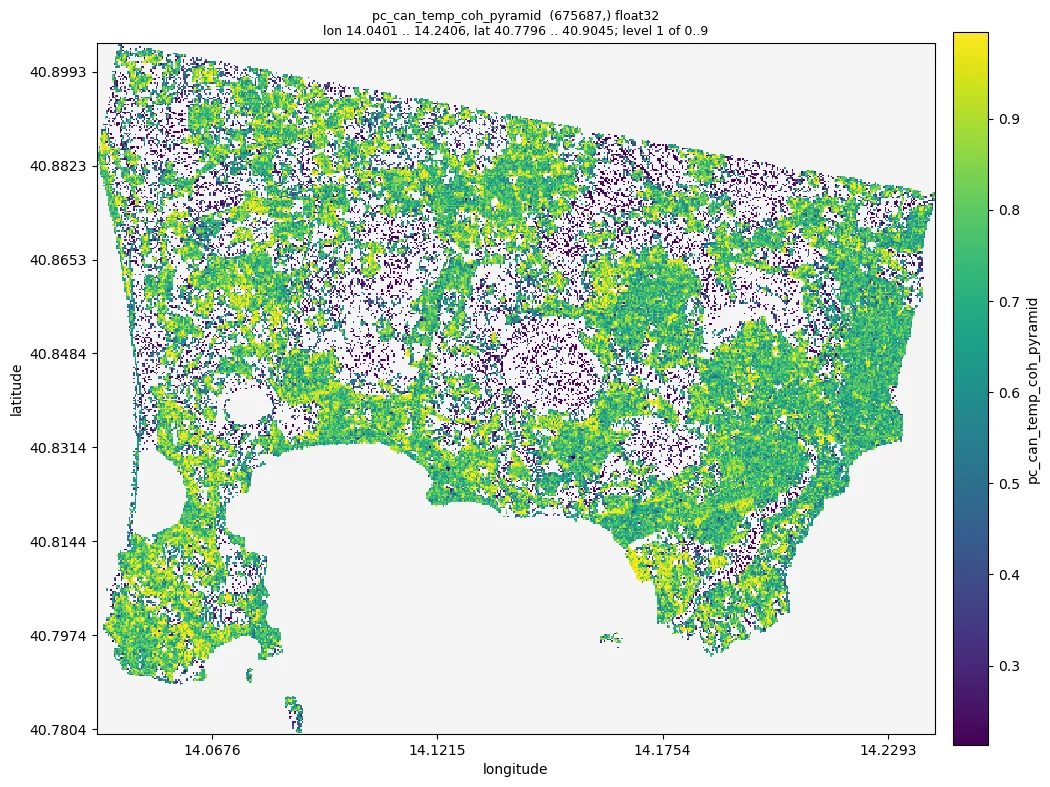
Temporal coherence of the merged candidates after the Noise2Fringe Transformer (pc/pc_can_temp_coh_pyramid).
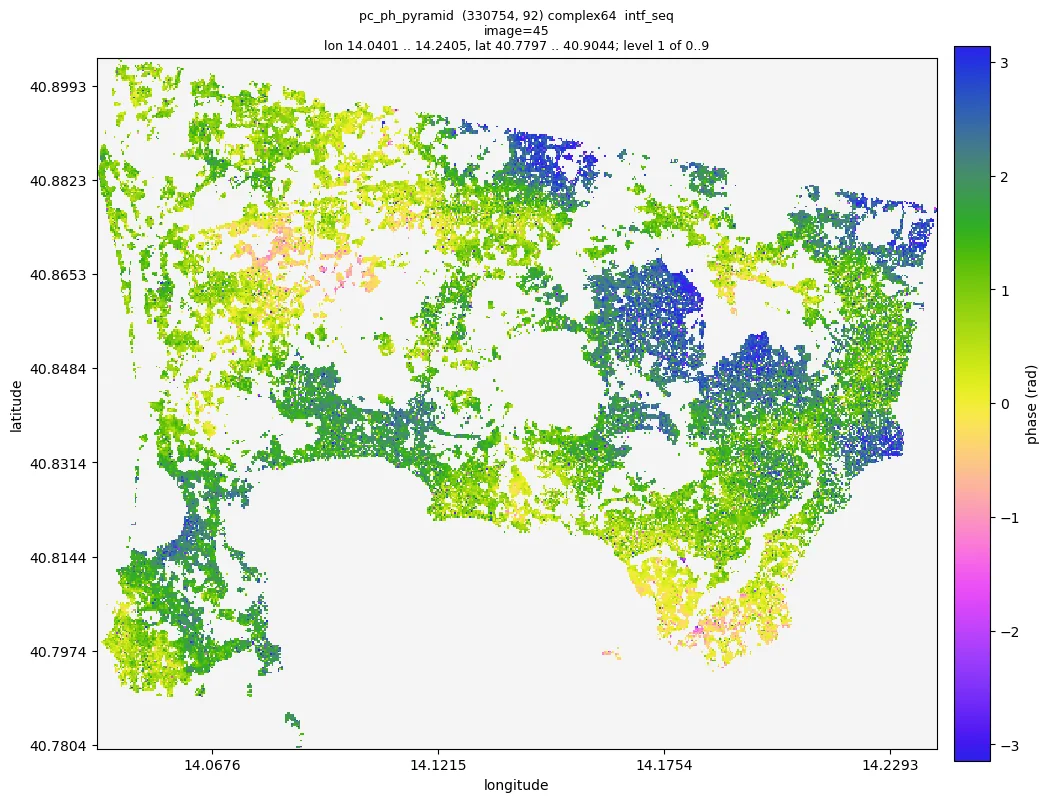
Sequential interferogram 45 (2020-07-07 / 2020-07-19) of the refined points (pc/pc_ph_pyramid --show intf_seq
--index 45): continuous phase, no noise.
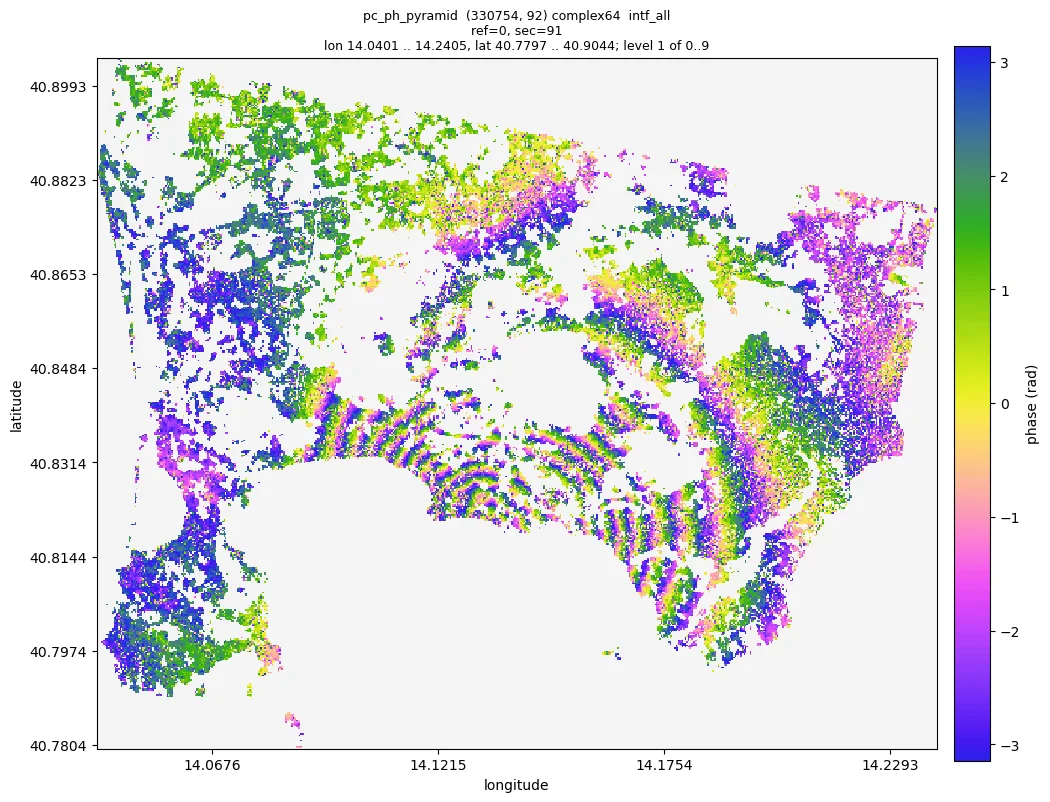
Interferogram 2019-01-02 / 2021-12-29 of the refined points (--show intf_all --index 0 91): the concentric fringes
of the caldera uplift centred on Pozzuoli, about ten fringes over three years.
Checks
moraine quicklook pc/pc_ph_pyramid --show intf_seq --index I -o pc_intf.png: interferograms of the refined points should show smooth, spatially continuous phase (fringes), not noise.- Compare with the raw interferogram:
moraine quicklook raw/rslc_pyramid --show intf_seq --index I.
Problems
n2ftis slow on CPU; use a GPU.- Too few points: lower the temporal coherence threshold or revisit PS / DS thresholds.