02 PS candidates
Pipeline: examples/02_ps.toml. Tutorial: nbs/Tutorials/CLI/CampiFlegrei/02_ps.ipynb. Needs 01_load.
Set [vars] shape to the (nlines, width) of raw/rslc.zarr (--var shape=NLINES,WIDTH; the default is the
sample data set) and [defaults] cuda = false without a GPU.
Steps
Two candidate sets are merged:
- Amplitude dispersion index (
amp-disp, ADI = std / mean of the amplitude over time). Stable scatterers have a low ADI. Candidates:ras<0.4(pc-logic-ras). - Noise2Fringe temporal coherence:
image-pairs(bandwidth 1, sequential pairs) ->n2ffilters the interferograms ->temp-cohcompares filtered and raw phase. Candidates:ras>0.58. pc-unionof both sets,pc-hix+pc-sortto hilbert order,ras2pctakes rslc, e/n, lon/lat and ADI of the candidates.
Outputs (WORK/ps/): ps_can_hix.zarr (n_points,), ps_can_rslc.zarr (n_points, nimages),
ps_can_{e,n,lon,lat,adi}.zarr; rasters ras_adi.zarr, ras_temp_coh.zarr, ras_n2f_intf.zarr;
pyramids ras_adi_pyramid, ras_n2f_intf_pyramid (the filtered interferograms, averaged for the overview),
ras_temp_coh_pyramid, ps_can_adi_pyramid; all pyramids but the rslc one are built with method = "mean",
a multilook of the data, so the whole scene is readable.
Parameters
- ADI threshold: 0.25-0.4 is common; lower = fewer, more stable points. With few images (< ~20) the ADI is noisy, so the n2f criterion matters more.
- n2f temporal coherence threshold: 0.5-0.7; the tutorial uses 0.58.
n2fneeds the models (moraine.download_dl_model()) and PyTorch; it is much faster withcuda, where the network runs in half precision (the phases are within about 1e-3 rad of the CPU result).adiandn2f_temp_cohrun on the CPU (cuda = falsein the step): they read the stack once and reduce it, and starting a GPU worker costs more than the GPU saves. Their GPU versions stay available.
Expected results (sample data, Campi Flegrei, 981 x 4160 x 92)
| result | sample value | sane range |
|---|---|---|
ras_adi_pyramid |
p50 0.54, p01 0.26, p99 0.79, min 0.03 | ADI >= 0; p50 roughly 0.3-1 |
ras_temp_coh_pyramid |
p50 0.43, p99 0.97, max 0.999 | 0 <= t_coh <= 1 |
| candidates ADI < 0.4 | 148 706 | a few % to ~30 % of the land pixels |
| candidates t_coh > 0.58 | 530 416 | |
merged ps_can_hix |
530 886 (22 % of the 2.42 million land pixels) |
The t_coh counts vary by a few hundred between runs: the pixels without data get a random phase before the filtering, which moves the pixels near the threshold.
Run time: about 40 s with an A100 (n2f 18 s).
Figures
Quicklooks of the sample data run of 2026-10-10 (the numbers above are from the same run):
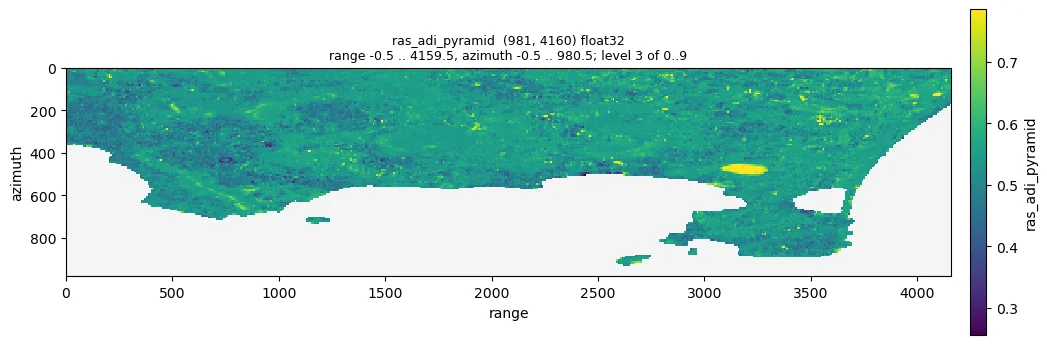
Amplitude dispersion index (ps/ras_adi_pyramid): low on the stable scatterers of the towns.
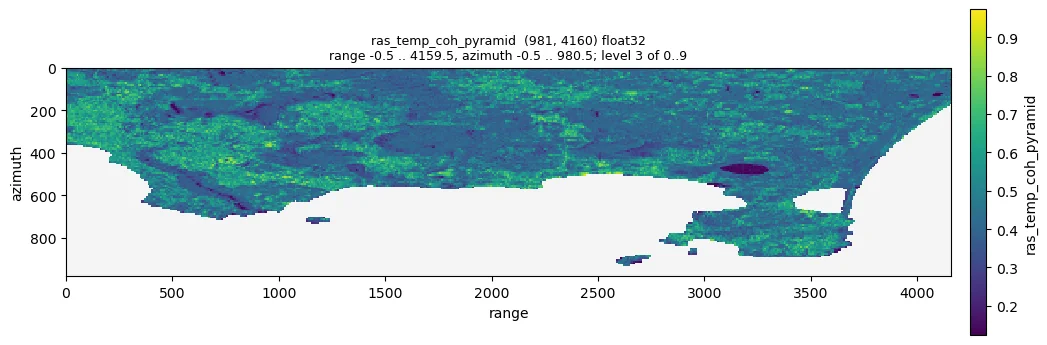
Noise2Fringe temporal coherence (ps/ras_temp_coh_pyramid): high on built-up areas, low on the crater lakes and
vegetation.
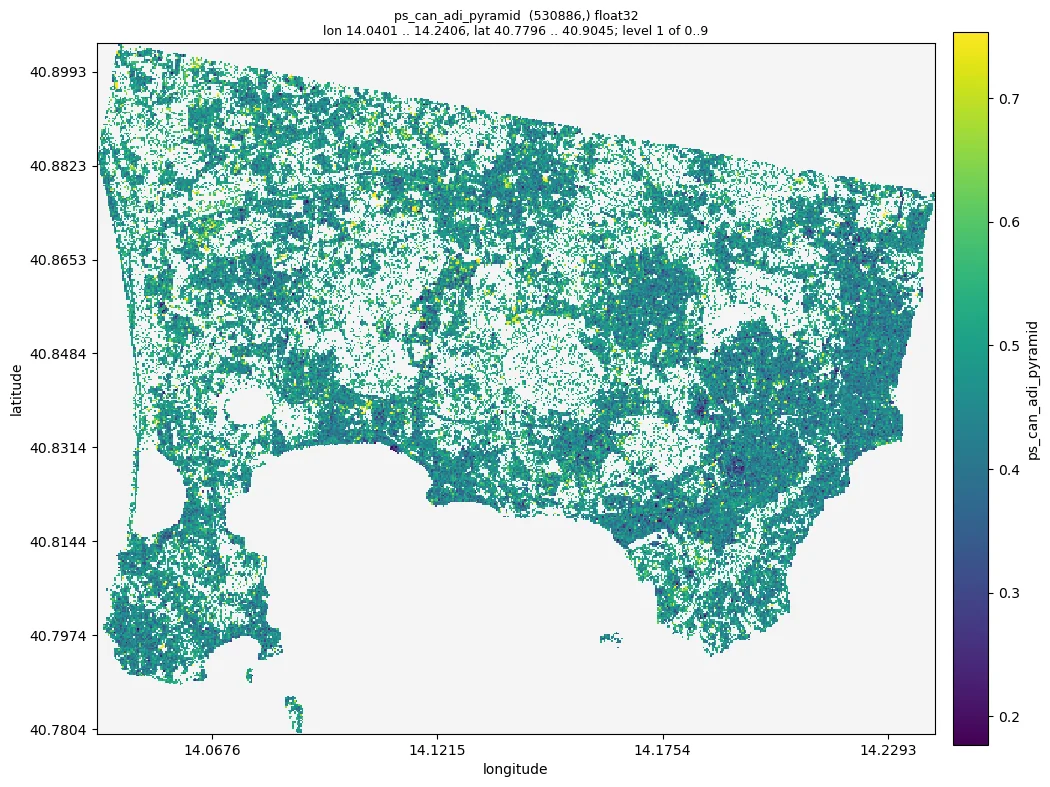
The merged PS candidates on the map, coloured by their amplitude dispersion (ps/ps_can_adi_pyramid): Pozzuoli,
Bacoli and the western suburbs of Naples, not the craters and slopes.
Checks
moraine info ps/ras_adi_pyramid ps/ras_temp_coh_pyramid: values within the ranges above, no warnings.moraine quicklook ps/ras_n2f_intf_pyramid --index I -o intf.png: the I-th filtered sequential interferogram of the whole scene (averaged): fringes continuous, noise only where the coherence is low; the decimatedraw/rslc_pyramidshows the same interferograms only zoomed in.moraine quicklook ps/ras_temp_coh_pyramid -o tcoh.png: high coherence on built-up / rocky areas, low on vegetation and water.moraine quicklook ps/ps_can_adi_pyramid -o ps.png: candidates spread over the stable areas.
Problems
- Almost no candidates: check the ADI distribution; with a short stack raise the ADI threshold or rely on the n2f set.
n2ffails with a missing model file: runpython -c "import moraine; moraine.download_dl_model()".- CUDA out of memory: only one GPU pipeline at a time; or set
cuda = false.